 Marine Industry
Marine Industry
Marine Industry
 Marine Industry
Hydrofluoric Acid supplier
Hydrofluoric Acid dealer and Suppliers in Mumbai and Navi Mumbai. HF is classified as one of the strongest inorganic acids, is usedmainly for industrial purposes (eg, glass etching, metal cleaning, electronics manufacturing). Hydrofluoric acid also may be found in home rust removers. Hydrofluoric acid is a colourless solution of hydrogen fluoride in water.
 Marine Industry
Phenolphthalein supplier and exporter
Product Name ::: Phenolphthalein ( White ) IP
CHEMICAL NAME ::: : 3, 3 Bis (p-Hydroxyphenyl) Phthalide
CAS NO. ::: : 77-09-08
MOLECULAR FORMULA : C20H1404
MOLECULAR WEIGHT : 318.32
Marine Industry
BIOLOGICAL STAINS AND INDCATORS
BIOLOGICAL STAINS AND INDCATORS WHOLE RANGE:
FIELD STAIN A AND FIELD STAIN B POWDERS
GIEMSA STAIN,LEISHMAN STAIN, WRIGHT STAIN
AZRUE A, B, II AND AZURE II EOSINATE.
METHYLENE BLUE ZINC FREE
PHENOL RED, AND BROMOPHENOL BLUE AND SODIUM SALTS
CRESOL RED AND BROMOCRESOL PURPLE AND SODIUM SALTS
THYMOL BLUE AND BROMOTHYMOL BLUE AND SODIUM SALTS
ALIZARIN, O-CRESOLPHTHALEIN, THYMOLPHATHALEIN COMPLEXONES
XYLENOL ORANGE, MUREXIDE, NEUTRAL RED, METHYL ORANGE, NEUTRAL RED SAFRANINE.
Marine Industry
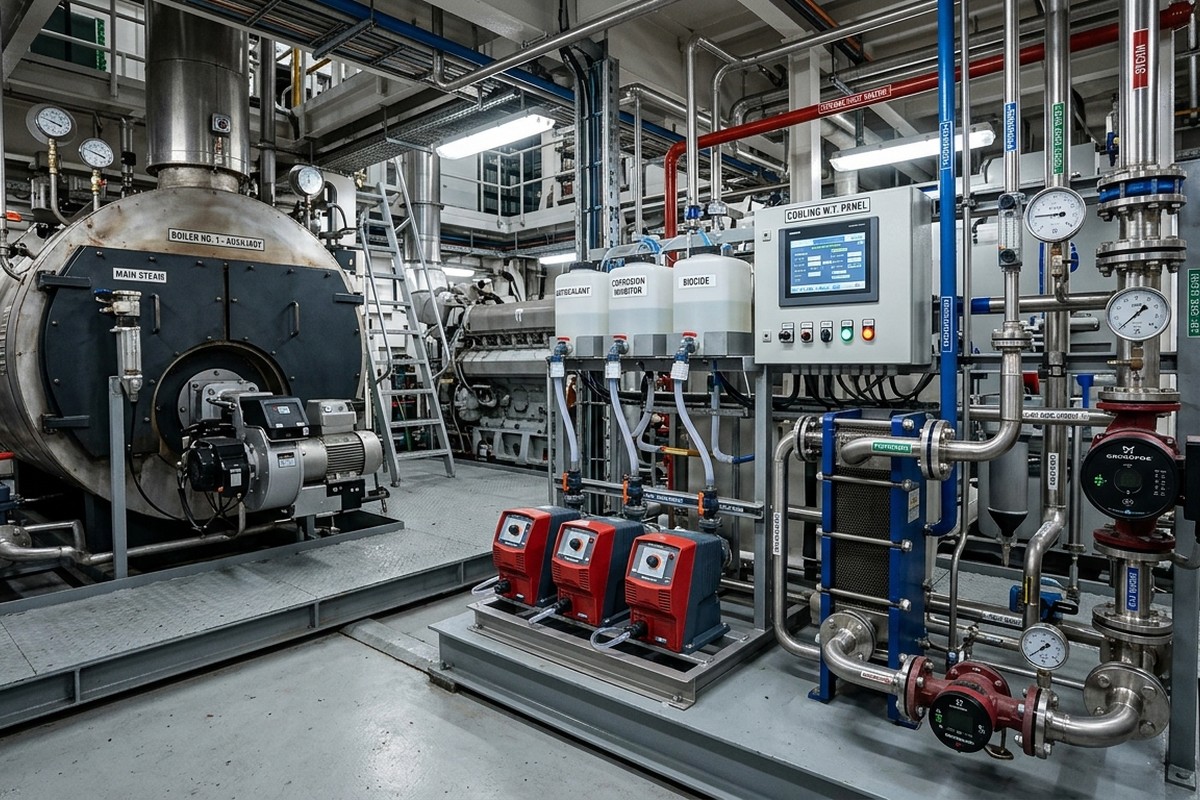
Boiler Treatment tips
Chemical feed should be continuous. Chemical pumping rates can create problems especially for neat feed set ups. Using on/off feed systems such as a recycle timer can create problems. Chemical feed pumps should be sized or product strengths should be adjusted to allow continuous feed.
Marine Industry
Oxygen scavengers for Boiler Water
Oxygen scavengers are best fed to the storage section of the deaerator or feedwater tank. In most low-pressure industrial boiler systems, if oxygen remains in the feedwater and enters the boiler, it is too late to remove all of the oxygen and protect the boiler and condensate from oxygen corrosion. A residual of sulfite or other.
Oxygen scavenger in the boiler cannot chemically reduce all of the oxygen before it escapes with the steam or reacts with the metal surfaces.
Marine Industry
Chelant Treatment for Boiler
Chelant Treatment
EDTA dosage requirements and variations will be similar to phosphate in that there is a reaction and residual portion to the dosage calculation:
(Feedwater hardness) x (3.8) % active / 100 + ppm EDTA desired residual / (feedwater cycles) x % active / 100 = ppm EDTA Product
Marine Industry
Sodium Hexametaphosphate to precipitate calcium in low-pressure boilers
Sodium Hexametaphosphate supplier
Sodium hexametaphosphate is a commonly used source of orthophosphate anion used to precipitate calcium in low-pressure boilers. With dispersants the calcium phosphate becomes a fluidized sludge capable of being blown down and out of the boiler before the calcium can form a deposit.
Example
The reaction rate is the first part of the equation and the residual the second part:
[ (0.72 x Ca + 1.08 x PO4/ Feedwater Cycles) ]
= ppm of 100% sodium hexametaphosphate in feedwater.
 Marine Industry
Sodium Sulfite as Oxygen Scavenger
The dosage of sodium sulfite or other oxygen scavengers may be calculated by looking at their reaction rate to remove the oxygen and then their residual dosage to provide a feedwater or boiler water residual.
Sodium Sulfite Example
The reaction rate is:
2Na2SO3 (7.88 ppm) + O2 ( 1 ppm) → 2Na2SO4
For the residual, 1.6 ppm Na2SO3 will yield 1 ppm SO3.
The total calculation equation to remove residual oxygen and provide a boiler water residual is:
 Marine Industry
Marine Industry
Marine Industry
Hydrazine Test Kit supplier in Middle East
Directions for use : Based on Colorimetric Procedure
 Marine Industry
H2S KITS FOR WATER SAMPLE TEST
H2S KITS FOR WATER SAMPLE TEST. H2SKIT FOR BACTERIOLOGICAL TEST FOR DRINKING WATER. We are one of popular manufacturer and supplier of H2S Test kit in Mumbai, Kandla - Gnadhidham, Chennai - Ennore, Visakhapatnam, Kolkata - Haldia, Dubai, Sharjah, Fujairah.
Using procedure of H2S kit and its benefit are available on this link-
http://rxmarine.com/H2S-vial-Bacteriological-Kit-manufacturer-supplier-test-kit
Email us : mail@rxmarine.com