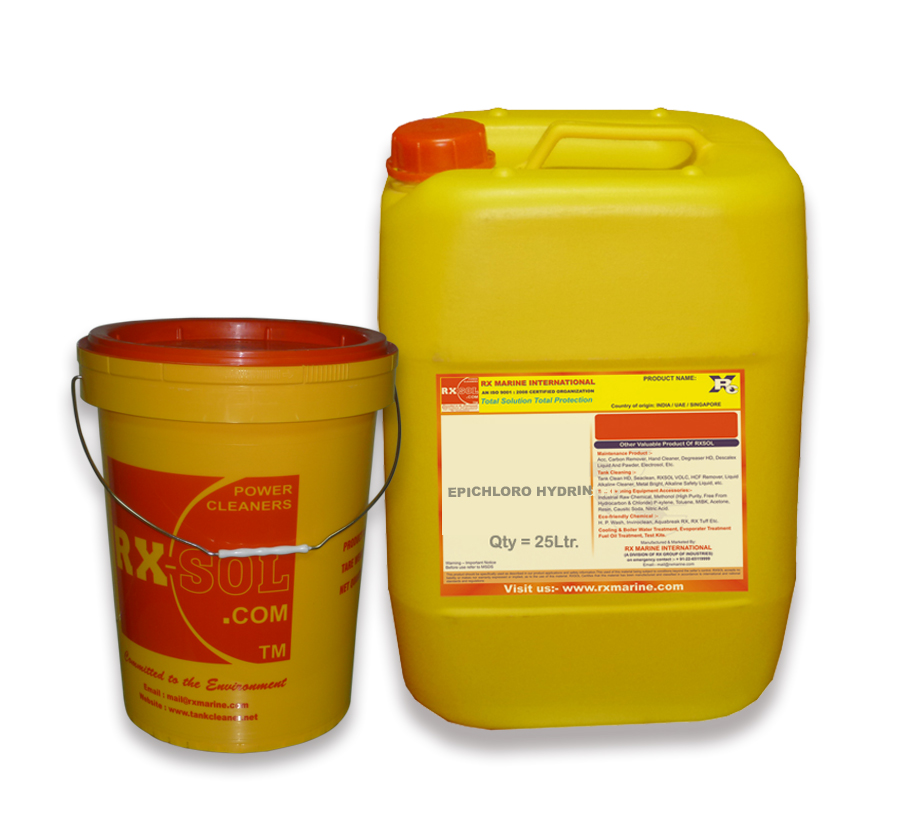
EPICHLOROHYDRIN
PURE EPICHLORHYDRIN used extensively as an industrial intermediate, a laboratory reagent, and as an insecticide.
Key Technical Details
| Standard packing | 25.00 Ltr. |
|---|
<div>
Applications:</div>
<ul>
<li>
Epichlorohydrin is mainly used in the production of epoxy resins. It was also used as a solvent for paints, varnishes, lacquers, cellulose esters and ethers, and gums.</li>
<li style="text-align: justify;">
Epichlorohydrin was historically used as an insecticide fumigant.Epichlorohydrin is used to make glycerol,epoxy resins, adhesive, and castings; asderivatives for producing dyes, pharmaceuticals, surfactants, and plasticizers; and asa solvent for resins, gums, paints, andvarnishes.Commercially the most important use is production of glycerine. Large volumes are consumed in nonglycerine areas, which largely consist of the various epoxy resins.</li>
<li>
It has use as a solvent and in the production of epichlorohydrin rubber.Solvent for natural and synthetic resins, gums, cellulose esters and ethers, paints, varnishes, nail enamels and lacquers, cement for Celluloid. As stabilizer.</li>
</ul>
<p style="text-align: justify;">
In biochemistry, it can be used as a crosslinking agent for the production of Sephdex size-exclusion chromatography resins. However, it is a potential carcinogen, and can cause various kinds of side effects on respiratory tract and kidneys. It can be manufactured through the reaction between allyl chloride with hypochlorous acid as well as alcohols.Epoxy resins of the bisphenol A type are synthesized from epichlorhydrin and bisphenol A. This leads to bisphenol-A diglycidyl ether, which is the monomer of bisphenol-A-based epoxy resins. Sensitization to epichlorhydrin occurs mainly in workers in the epoxy-resin industry. Sensitization in individuals not working at epoxy resin plants is rare. It has however been described to occur after contact with a soil fumigant, due to solvent cement and in a worker in a pharmaceutical plant, in a division for drug synthesis. Epichlorhydrin was used for the production of both drugs propranolol and oxprenolol<span style="color: rgb(51, 51, 51); font-family: Arial, Helvetica, sans-serif; font-size: 14px;">.</span></p>
<div>
Physical Properties:</div>
<div>
</div>
<div>
<table border="0" cellpadding="1" cellspacing="1">
<tbody>
<tr>
<td style="text-align: justify;">
Melting point<span style="white-space: pre;"> </span></td>
<td style="text-align: justify;">
-57 °C</td>
</tr>
<tr>
<td style="text-align: justify;">
Boiling point</td>
<td style="text-align: justify;">
115-117 °C(lit.)</td>
</tr>
<tr>
<td style="text-align: justify;">
Density</td>
<td style="text-align: justify;">
1.183 g/mL at 25 °C(lit.)</td>
</tr>
<tr>
<td style="text-align: justify;">
Vapour density </td>
<td style="text-align: justify;">
3.2 (vs air)</td>
</tr>
<tr>
<td style="text-align: justify;">
Vapour pressure </td>
<td style="text-align: justify;">
13.8 mm Hg ( 21.1 °C)</td>
</tr>
<tr>
<td style="text-align: justify;">
Refractive index </td>
<td style="text-align: justify;">
n20/D 1.438(lit.)</td>
</tr>
<tr>
<td style="text-align: justify;">
Flash point </td>
<td style="text-align: justify;">
93 °F</td>
</tr>
<tr>
<td style="text-align: justify;">
Storage temprature </td>
<td style="text-align: justify;">
Store below +30°C.</td>
</tr>
<tr>
<td style="text-align: justify;">
Solublity </td>
<td style="text-align: justify;">
65.9g/l</td>
</tr>
<tr>
<td style="text-align: justify;">
Form</td>
<td style="text-align: justify;">
Liquid</td>
</tr>
<tr>
<td style="text-align: justify;">
Specific gravity</td>
<td style="text-align: justify;">
1.183 (20/4℃)</td>
</tr>
<tr>
<td style="text-align: justify;">
Explosive limit </td>
<td style="text-align: justify;">
3.8-21%(V)</td>
</tr>
<tr>
<td style="text-align: justify;">
Water solublity </td>
<td style="text-align: justify;">
6 g/100 mL (10 ºC)</td>
</tr>
<tr>
<td style="text-align: justify;">
Dielectric constant</td>
<td style="text-align: justify;">
22.9(20℃)</td>
</tr>
<tr>
<td style="text-align: justify;">
Stability</td>
<td style="text-align: justify;">
Unstable. Flammable - note wide explosion limits and low flash point.</td>
</tr>
</tbody>
</table>
</div>
Need EPICHLOROHYDRIN for your operation?
Our team helps with product selection, dosage, safety data and delivery worldwide.
Request a Quote