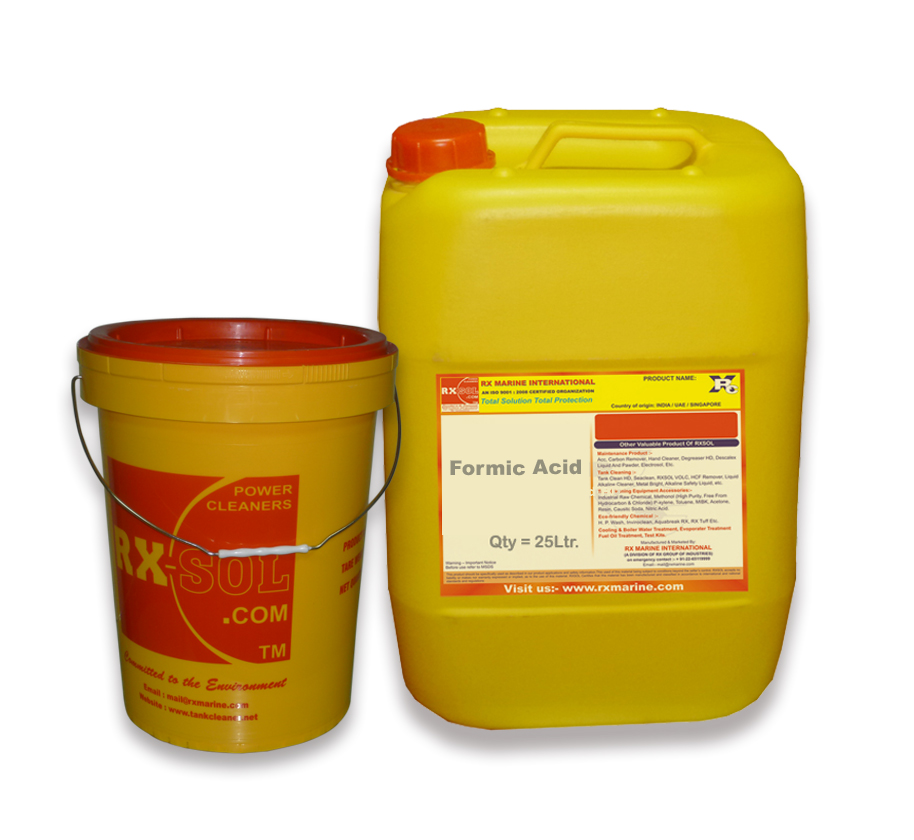
FORMIC ACID
Part No. RXSOL-19-1193-250
Methanoic Acid
Formic acid use as a preservative, antibacterial agent, cleaning agent and coagulant in rubber industries.
Key details
| Part number | RXSOL-19-1193-250 |
|---|---|
| Generic name | Methanoic Acid |
| Standard packing | 250.00 Kg |
| Supply locations | FORMIC ACID manufacturer supplier distributor in Mumbai, Kandla, Kolkata, Vizag, Chennai, India, Fujairah, Dubai, Sharjah, UAE, Gulf, Middle East, Muscat Oman, Kenya Africa. Get the best quality of FORMIC ACID 85% at a competitive price from us. We have ready stock of FORMIC ACID in India, UAE Gulf, Muscat, Barka Oman, Kenya Africa. Contact us for bulk as well as small orders. |
Need this product at your port or plant?
Enquire Now<div id="cke_pastebin">
Formic acid is as a preservative and antibacterial agent. </div>
<div id="cke_pastebin" style="text-align: justify;">
Formic acid arrests certain decay processes and causes the feed to retain its nutritive value longer, and so it is widely used to preserve winter <span style="font-size: 14px;">feed for cattle</span>. In the poultry industry, it is sometimes added to feed to kill E. coli bacteria. </div>
<div id="cke_pastebin">
</div>
<div id="cke_pastebin" style="text-align: justify;">
Use as <span style="font-size: 16px;">preservative</span> for silage and (other) animal feed.</div>
<div id="cke_pastebin">
</div>
<div id="cke_pastebin" style="text-align: justify;">
Formic acid is also significantly used in the production of leather, including tanning, and in dyeing and finishing textiles because of its acidic nature. <br />
<br />
Use as a <span style="font-size: 16px;">coagulant</span> in the production of rubber.<br />
<br />
Formic acid is also used in place of mineral acids for various <span style="font-size: 16px;">cleaning products</span> such as limescale remover and toilet bowl cleaner. </div>
<p>
<span style="font-size: 14px;">Formic acid is an organic acid having many industrial applications demand.</span></p>
<p>
</p>
<div id="cke_pastebin">
<table border="0" cellpadding="1" cellspacing="1">
<tbody>
<tr>
<td>
PRODUCT NAME </td>
<td>
:</td>
<td>
FORMICACID </td>
</tr>
<tr>
<td>
CAS number </td>
<td>
:</td>
<td>
64-18-6</td>
</tr>
<tr>
<td>
UN number </td>
<td>
:</td>
<td>
1779</td>
</tr>
<tr>
<td>
Formula </td>
<td>
:</td>
<td>
HCOOH</td>
</tr>
<tr>
<td>
Odour </td>
<td>
:</td>
<td>
PENETRATING</td>
</tr>
<tr>
<td>
Solubility in water </td>
<td>
:</td>
<td>
COMPLETE</td>
</tr>
<tr>
<td>
Density </td>
<td>
:</td>
<td>
1.22 at 20 oC</td>
</tr>
<tr>
<td>
Boiling point </td>
<td>
:</td>
<td>
101oC</td>
</tr>
<tr>
<td>
Melting point </td>
<td>
:</td>
<td>
8 oC</td>
</tr>
<tr>
<td>
Viscosity </td>
<td>
:</td>
<td>
1.80 cp at 20oC</td>
</tr>
<tr>
<td>
Flashpoint </td>
<td>
:</td>
<td>
42oC</td>
</tr>
<tr>
<td>
Explosive limits </td>
<td>
:</td>
<td>
10 – 45.5 Vol%</td>
</tr>
<tr>
<td>
Vapour pressure </td>
<td>
:</td>
<td>
42 mbar at 20oC</td>
</tr>
<tr>
<td>
Skin absorption/irritation </td>
<td>
:</td>
<td>
YES</td>
</tr>
<tr>
<td>
TLV Country NL Year 1995 </td>
<td>
:</td>
<td>
5 ppm 9 mg/m3</td>
</tr>
<tr>
<td>
Pollution category 1994</td>
<td>
:</td>
<td>
D</td>
</tr>
</tbody>
</table>
</div>
<p>
</p>
</div>
<div id="cke_pastebin">
<span style="font-size: 14px;">Formic acid also enables rapid and long-lasting <strong>deicing agent</strong> for runways and roads</span> ::: </div>
<div id="cke_pastebin" style="text-align: justify;">
Formates, the salts of formic acid, rapidly remove thin layers of ice and effectively prevent new snow from sticking or a new layer of ice from forming. Also, the waste water polluting effect is much less than that of other deicing agents because of their good biodegradability and low oxygen demand during the breakdown process. Depending on the concentration of the deicing agent, the freezing point is reduced to as much as minus 50 degrees Celsius.<br />
<br />
In the past, urea was the preferred deicing agent for airport runways. Because urea has a high impact on the environment, potassium acetate and potassium formate soon replaced urea. In fact, <strong><span style="font-size: 14px;">potassium formate is gradually replacing potassium acetate</span></strong> because it is even more efficient and eco-friendly.</div>
</div>
Need FORMIC ACID for your operation?
Our team helps with product selection, dosage, safety data and delivery worldwide.
Request a Quote